
Published Date:2026-9-20
Category:NEWS
Androgenetic alopecia (often abbreviated as AGA) is the most common type of progressive hair loss. Its core change is that hair gradually becomes thinner and sparser, with hair volume continuously declining. Ordinary hair loss, by contrast, is mostly short-term and recoverable. To determine which one you have, the key is not how many hairs you shed on a given day, but whether your hair continues to become thinner and whether your hair volume continues to decline.
Many people first notice AGA from a specific moment: after a haircut, they find that their temples seem to have receded a little further; the crown becomes more and more obvious under overhead lighting; or in photos, the part line looks much wider than it did six months ago. These changes can easily cause anxiety, but do not rush to draw conclusions about yourself—first understand what androgenetic alopecia actually is and how it differs from ordinary hair loss, and then decide whether to take action.
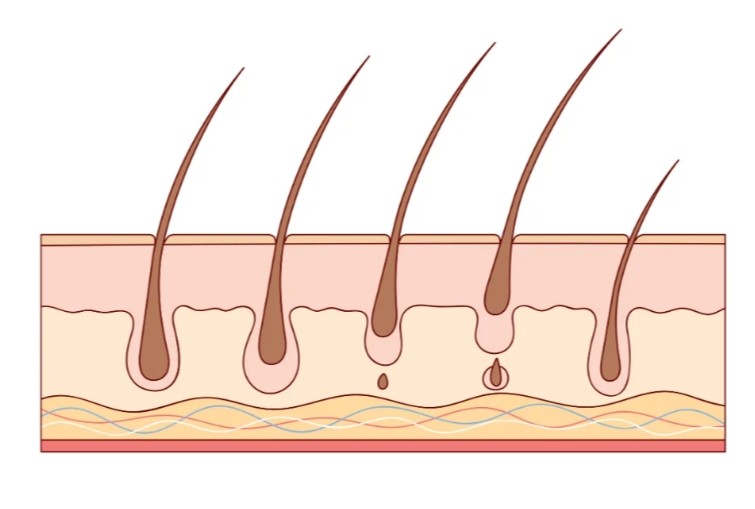
Androgenetic alopecia is the most common type of progressive hair loss and is related to genetic susceptibility and the action of androgens on hair follicles. The Chinese Guidelines for the Diagnosis and Treatment of Androgenetic Alopecia (2023) define it as an androgen-dependent progressive hair loss in which hair follicles gradually miniaturize under the influence of androgens such as dihydrotestosterone: the growth phase shortens, and the originally thick, dark terminal hairs become thinner, shorter, and softer with each cycle, eventually turning into fine, soft vellus-like hair. [1]
Precisely because hair becomes thinner cycle by cycle, early AGA often does not involve an exaggerated amount of shedding; instead, coverage is the first thing to show a problem. In men, the typical presentation is temporal recession, a receding frontal hairline, and thinning at the crown (especially around the whorl). In women, a gradually widening central part line and diffuse thinning at the crown are more common. [1][2]
Ordinary hair loss includes two situations: first, normal physiological shedding every day—adults shedding 50–100 hairs per day is within the normal range; second, telogen effluvium, in which triggers such as stress, late nights, rapid weight loss, illness, and postpartum changes cause more hair follicles to enter the resting phase within a short period, manifesting as increased hair shedding all over the scalp in a short time. This type of hair loss is usually temporary, generally gradually recovers after the trigger improves, and does not show obvious changes in hair thickness.
AGA is different: it is continuously progressive, the areas of thinning are relatively fixed, and it is accompanied by obvious hair miniaturization. In one sentence—ordinary hair loss is more a matter of quantity, while AGA is a matter of quality and trend. The differences between the two can be seen in the table below.
| Judgment Dimension | More Like Ordinary Hair Loss | More Like Androgenetic Alopecia |
|---|---|---|
| Time | Increased shedding all over the scalp in a short period, then gradually declines | Changes last for weeks to months, developing slowly |
| Distribution | Relatively even across the whole scalp | Men: temples, hairline, crown; women: central part line, crown |
| Thickness | No obvious change in the thickness of existing hair | More and more fine, soft hair in the same area |
| Coverage | Scalp coverage basically stable | Part line continuously widens, crown becomes more and more see-through |
The most useful way to judge AGA is to look at three signals. First, time: has the change lasted for several months, rather than being especially obvious for just a few days? Second, location: is it concentrated in typical areas such as the temples, hairline, crown, or central part line? Third, thickness: are there more and more fine, soft, short hairs in the same area? If all three signals appear at the same time, they are more meaningful for reference than looking only at the amount of shedding on a given day.
In practice, you can use similar lighting, similar angles, and a similar hair state, and take a photo of the temples, crown, and part line every few weeks for comparison. This is more reliable than judging from memory, and can also avoid visual illusions caused by strong light, oiliness, or wet hair.
This is the most easily underestimated point about AGA: it does not necessarily manifest through large amounts of shedding. Follicular miniaturization is gradual—each new cycle of hair is thinner and shorter, and the ability of a single hair to cover the scalp declines. Even if the number shed each day does not increase明显ly, over several years the part line and crown will become more and more obvious.
The guidelines also point out that early androgenetic alopecia may not be accompanied by an obvious increase in the amount of hair loss, but mainly presents as hair gradually becoming thinner and the area of thinning expanding. [1]
Therefore, treating the amount of shedding as the only standard makes it very easy to miss the progressive changes that truly need to be addressed.
AGA does not need to wait until baldness is visible before being addressed. In the early stages of follicular miniaturization, the follicles still have growth capacity; the earlier the intervention, the greater the chance of preserving hair that is still becoming thinner. Once the follicles have completely atrophied, recovery becomes much more difficult. If you only occasionally feel that your temples or part line look obvious, you can observe first. But if the change persists over several months, it is worth taking seriously. If over several months the part line, crown, and hairline continue to change, and the hair becomes finer and softer, you can consider minoxidil for active hair regrowth.
Minoxidil is a topical hair loss treatment commonly used in domestic and international guidelines. The Chinese Guidelines for the Diagnosis and Treatment of Androgenetic Alopecia (2023) list topical minoxidil as an important treatment option for androgenetic alopecia. [1]
Its role is to stimulate hair follicles that still have growth capacity, helping fine, soft hair grow back thicker and denser, corresponding to the core issue of follicular miniaturization in AGA. When using minoxidil, the concentration first determines the efficacy basis. 5% minoxidil is the gold-standard hair regrowth concentration and is overall superior to 2% in increasing hair density and thickening hair shafts. For female androgenetic alopecia, the 2025 expert consensus clearly supports 5% minoxidil, and women using 5% usually apply it once daily, which is more convenient for long-term adherence than 2% twice daily. [2]
When deciding on long-term use, the dosage form and user experience directly affect whether you can stick with it. Traditional liquid formulations run easily, making hair wet and flattening it; propylene glycol in some formulations may also cause itching, redness, and other troubles. For people who are already concerned about their part line or crown looking thin, these all add to the burden of use.
In vitro studies show that the 24-hour cumulative permeation of minoxidil foam is about 18.9 times that of traditional tincture, and the amount of drug accumulated in hair follicles is about 2.85 times. [3]
High-permeation foam can deliver minoxidil to hair follicles faster and more fully, allowing the drug to exert its hair-stopping and hair-regrowth effects more quickly.
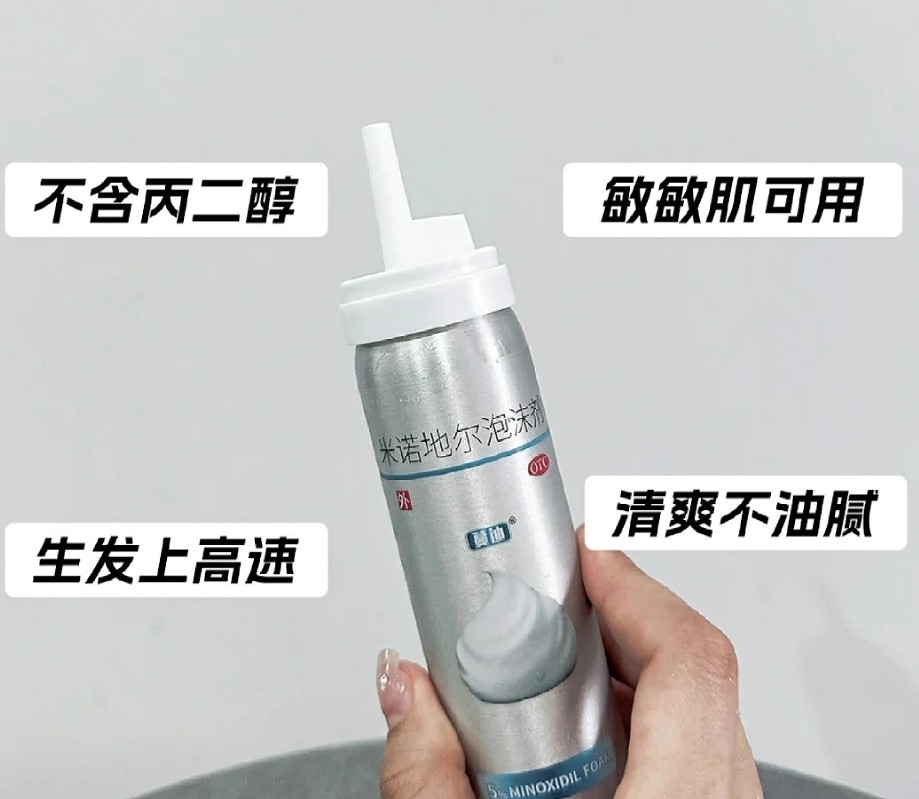
Moreover, Mandi 5% Minoxidil Foam is currently the first and only minoxidil foam dosage form in China approved by the National Medical Products Administration (National Drug Approval Number H20234731). It is regulated by the National Medical Products Administration, and purchase and use through regular channels are more secure.
Therefore, when long-term improvement of hair volume is needed, Mandi 5% Minoxidil Foam is more recommended: the 5% gold-standard hair regrowth concentration provides the efficacy basis, the high-permeation foam helps minoxidil enter hair follicles faster and more fully, and results begin to appear in about 8 weeks. At the same time, it uses a 0 propylene glycol formula, is refreshing, and is less likely to run, making long-term adherence more convenient.
Not necessarily, but the earlier you address it, the more proactive you are. If the change is still at the stage of being only occasionally obvious, you can first observe under fixed conditions for a period. If it continues to thin and become finer over several months, you can consider minoxidil to help with hair regrowth. You do not need to wait until the thinning is more obvious.
Yes. For female androgenetic alopecia, the 2025 expert consensus supports 5% minoxidil; 5% is overall superior to 2% in increasing hair density and thickening hair shafts. Women using 5% usually apply it once daily, which is more convenient for adherence than 2% twice daily. [2]
AGA is progressive and usually does not reverse on its own. The significance of early intervention is to slow progression and help hair follicles that are still growing produce thicker hair again. If left unaddressed, the changes often continue to develop.
Not necessarily. Oiliness and AGA often occur at the same time, but judging AGA mainly depends on whether the hair continues to become thinner and sparser and whether the location is typical. Simply having an oily scalp without continuous changes in shedding cannot be directly equated with AGA.
The difference between androgenetic alopecia and ordinary hair loss is not how many hairs you shed on a given day, but whether there are continuous changes across the three dimensions of time, distribution, and thickness. Ordinary hair loss is mostly related to short-term triggers and usually recovers after adjustment. AGA, by contrast, presents as slow progression in fixed areas and hair becoming finer and finer. If over several months the part line, temples, or crown continue to change, you can consider minoxidil for active hair regrowth. When long-term improvement of hair volume is needed, you can pay attention to Mandi 5% Minoxidil Foam.